


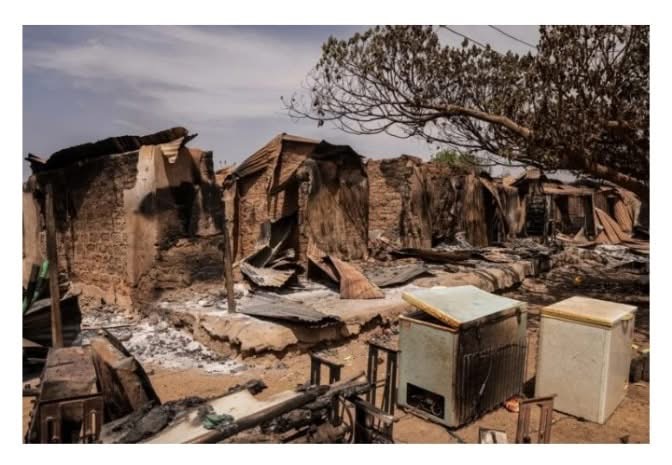
Emerging security threats have been identified due to the increasing presence of Boko Haram factions and allied armed groups operating from the Kainji National Park region. Military strategists are cautioning that if the Federal Government does not take action to dismantle this terror enclave, jihadist attacks could soon spread to major cities in the South-West.
This warning follows last Tuesday’s coordinated attacks on Woro and surrounding communities in the Kaiama Local Government Area of Kwara State, where at least 176 residents were reportedly killed in one of the deadliest incidents in the state’s history.
The attackers targeted the area after villagers allegedly refused to comply with militant demands, highlighting the expanding influence of violent extremist groups beyond the traditional North-Eastern region of Nigeria.
Security experts indicate that these killings signify a dangerous shift in Nigeria’s terror landscape, bringing insurgent activities alarmingly close to the country’s economic and population centers.
Kainji National Park, located just 90 kilometers from Ilorin, the capital of Kwara State, and less than 400 kilometers from Lagos, has reportedly transitioned from a wildlife sanctuary into a significant hideout for jihadist groups, bandits, and organized criminal networks.
Spanning around 5,340 square kilometers of dense forest, savannah, and rocky terrain across Kwara and Niger states, the park now provides cover for insurgents displaced by military operations in the North-West and North-East, including factions linked to Boko Haram.
According to military and counter-terrorism analysts, the scale of killings attributed to insurgent commander Abubakar Saidu, also known as Sadiku, within a single week in Kwara rivals the casualty figures from many Boko Haram attacks in the North-East in 2025.
They warn that unless a large-scale, intelligence-driven operation is launched urgently across the Kwara–Kogi–Niger axis, the militants could solidify their presence, establish sleeper cells, and exploit forest corridors and weak rural surveillance to advance into the South-West.
In a conversation with Sunday PUNCH, retired Maj.-Gen. Peter Aro, a former Troop Commander and Director of Information and Communication Technology at the Nigerian Army Signals Headquarters, advised against treating the crisis as a conventional war, stressing that the proximity of Woro to Ilorin should raise significant alarms.
“Terrorist organizations do not act abruptly; they progress slowly. They set up sleeper cells, monitor communities, chart routes, assess response times, and take advantage of weak governance before executing significant attacks,” Aro stated.
He noted that any signs of sleeper cells in the South-West would indicate that infiltration is already in progress.
He cautioned that being complacent could have severe consequences, emphasizing that forest areas, border communities, and key transit routes should now be prioritized for security measures.
Aro highlighted Ondo State as especially at risk due to its extensive forests, limited rural access, and inadequate surveillance systems.
He remarked, “Terrorism quietly spreads before it erupts. Nigeria still has the opportunity to prevent gradual infiltration into the South-West, but denial and procrastination will only increase the costs.”
He characterized the nation’s security issue as an asymmetric conflict where assailants do not wear uniforms or control territory but instead hide in forests, integrate into rural areas, strike quickly, and vanish.
Aro cautioned that as the rains become heavier, thick vegetation, flooded paths, and cloud cover would make the Kainji forest even more difficult to access, effectively transforming it into a permanent base for insurgents.
Additionally, in an interview with Sunday PUNCH, a former Commandant of Army Signals and Chief of Defence Training and Planning, Maj.-Gen. Ishola Williams (retd.), criticized the military’s prolonged counter-terrorism approach, stating that Nigeria has not adapted or learned from its experiences despite over ten years of battling insurgency.
He pointed out that the same strategies have been reused for 10 to 15 years while the security situation has continued to worsen.
Williams questioned the effectiveness of previous international support, including assistance from American and British forces and the Multinational Joint Task Force.
“How is it possible for small groups of 200 attackers to invade communities and kill individuals without facing any resistance? Shouldn’t we feel ashamed?” he questioned.
He voiced his worries regarding reports that security agencies had been alerted prior to certain attacks but did not respond due to a lack of adequate firepower.
“In a properly functioning country, individuals would resign or be dismissed for such shortcomings. Are we held accountable in Nigeria?” Williams asked.
He also criticized the military for not showing enough concern for civilian lives, claiming that troops often stayed in their posts even after communities suffered deadly assaults.
Segun Onifade, a retired Assistant Commissioner of Police who worked in the area for five years, stated that Kainji National Park exemplifies Nigeria’s broader failure to secure extensive rural areas.
He advocated for the establishment of permanent joint military, police, and intelligence bases within and around the park, instead of sporadic raids.
“Access routes to the forest need to be monitored, illegal mining operations should be dismantled, and local informant networks disrupted,” Onifade suggested.
He called for coordinated efforts between Kwara and Niger, supported by shared intelligence systems and a unified command structure for the park corridor.
Onifade also emphasized the need to revive ranger services with armed protection, drones, and satellite surveillance, highlighting the necessity for a new security-conservation approach.
“Protected forests can no longer be regarded as neutral ecological areas. They have become frontline security zones,” he stated.
Kainji National Park, once famous for its elephants, antelopes, and ranger outposts, now reflects the effects of neglect. Ranger stations are left abandoned, conservation structures have fallen apart, and extensive areas are unregulated.
Abdulyekeen Mohd Bashir, a security analyst from Kwara living in Ibadan, indicated that this lack of oversight has created a space for armed groups to emerge.
“Terrorists expelled from Zamfara and other North-West regions have regrouped in Kainji due to its lax security,” he explained.
Bashir noted that factions of Boko Haram, individuals connected to Jama’at Nusrat al-Islam wal-Muslimin, and bandit groups are now operating in the corridor, sometimes engaging in conflicts over resources and territory.
Akeem Olatunji, another analyst, stated that the Kaiama attack highlighted vulnerabilities in Nigeria’s early-warning and response systems.
“Warnings were issued, quickly ignored, and everyone went to sleep until the attackers came,” he said.
According to Sunday PUNCH, the 407 Air Combat Training Group of the Nigerian Air Force in Kainji is one of the primary bases where the A-29 Super Tucano fighter jets, acquired during former President Muhammadu Buhari’s administration, are stored.
The 407 ACTG, a crucial Air Force unit located in the Kainji region, is responsible for training combat pilots and conducting air combat operations.
This unit is vital for national security, including the operational deployment of Alpha Jets and A-29 Super Tucano aircraft for counter-insurgency missions.
A high-ranking security source familiar with air operations, who spoke to Sunday PUNCH on the condition of anonymity due to lack of authorization, stated that some of the Super Tucano jets obtained under the Buhari administration are stationed at the Kainji air base, only minutes away by air from the Woro community.
“During the Buhari administration, some fighter jets were stationed at the 407 Air Combat Training Group base in Kainji. The distance to Woro, where the attack took place, is roughly a 10-minute flight,” the source mentioned.
He highlighted that the Super Tucanos were heavily utilized in various operations across the North-East during Buhari’s time, significantly impacting Boko Haram’s operational capabilities.
“I genuinely do not understand why similar air support was not provided in this region, considering the threat level,” the source added.
The Foundation for Peace Professionals, a civil society organization, expressed concerns about the actions of security agencies during the deadly incident.
Abdulrazaq Hamzat, the group’s Executive Director, questioned why air assets were not deployed by security forces, given the proximity of an Air Force base between Wawa and New Bussa, which is only 10 to 15 minutes away by air from the attack site.
“Why didn’t the government utilize the Air Force to stop the attackers while the assault was ongoing?” he asked, noting that even basic aerial surveillance could have been beneficial in tracking and apprehending the attackers.
Hamzat attributed the increasing insecurity to the Kainji corridor that connects parts of Niger, Kebbi, and Kwara states, which he described as a sanctuary for armed groups due to large ungoverned areas, dense forests, a weak security presence, and multiple escape routes.
He warned that this area provides a low-risk environment for operations, allowing attackers to strike and retreat with little fear of capture, a situation now exploited by Boko Haram splinter factions, JNIM-linked groups, and criminal bandit networks that sometimes compete but also share resources, intelligence, and routes.
He further criticized the poor coordination of security between states and the breakdown of early warning and rapid response systems, pointing out that credible warnings were allegedly not taken seriously.
He stated that failures in operational decision-making, including the lack of rapid reinforcements and post-attack pursuit, have emboldened armed groups.”
“Had aerial surveillance been implemented, we would have likely heard about arrests or counter-operations by now,” he remarked.
Meanwhile, the governments of Lagos and Osun states have stated that they are enhancing security measures in response to rising fears of potential terrorist infiltration into the South-West.
In a conversation with Sunday PUNCH, Gbenga Omotosho, the Lagos State Commissioner for Information and Strategy, explained that as part of its proactive measures, the state is relying on the Lagos Neighbourhood Safety Corps to provide intelligence to security forces.
Omotosho mentioned that plans are in place to recruit an additional 1,500 operatives to broaden the corps’ presence across communities in the state.
He also highlighted the Rapid Response Squad, which has recently received approximately 160 operational vehicles from the Lagos State Security Trust Fund.
He noted that both corporate organizations and private individuals are supporting this initiative to ensure that security agencies have the resources they need to operate effectively.
According to him, Lagos is also working in close partnership with other South-West states to create a unified and effective regional security strategy.
Omotosho emphasized the importance of citizen involvement for the success of these measures, urging residents to report any unusual activities in their areas.
“Security is a collective duty, not solely the government’s responsibility,” he remarked.
In an interview with one of our reporters, Samuel Ojo, the Special Adviser on Security to the Governor of Osun State, stated that the border with Kwara has been reinforced with additional security personnel.
Ojo also mentioned that residents of Osun communities near the Kwara border have been educated on the importance of providing timely and actionable intelligence to avert any infiltration.
He stated, “As I speak to you, we have increased security personnel at our borders with Kwara. We have soldiers, police officers, and members of the Nigeria Security and Civil Defence Corps stationed there.
“We have advised residents to be cautious about welcoming strangers. They should report any suspicious activities within the town and in areas lacking governance. The state government is diligently working to secure all our borders, particularly those adjacent to states vulnerable to insurgency,” Ojo added.
Additionally, Kwara State Governor Mallam Abdulrahman Abdulrazaq announced that high-ranking security officials, including the General Officer Commanding of the Nigerian Army’s 2 Division and a Deputy Inspector-General of Police, are present in the state to address the situation.
The governor shared this information in a statement from his Chief Press Secretary, Rafiu Ajakaye, which was provided to Sunday PUNCH on Saturday during the visit of Vice President Kashim Shettima, who led a Federal Government delegation to express condolences to the people of Kaiama and Kwara State following the attacks.
The governor praised the prompt response of the Federal Government, confirming that troops have been deployed and that Operation Savannah Shield is currently in progress.
Efforts to get comments from the governments of Ogun, Ondo, and Oyo states were unsuccessful, as their information commissioners did not respond to calls or text messages.
Similarly, attempts to contact Osun State’s Special Adviser on Security, Mr. Samuel Ojo, and the Chief Press Secretary of the Ondo State Governor, Ebenezer Adeniyan, were also unsuccessful, as neither responded to calls or messages by the time of publication.
(Punch Newspaper)